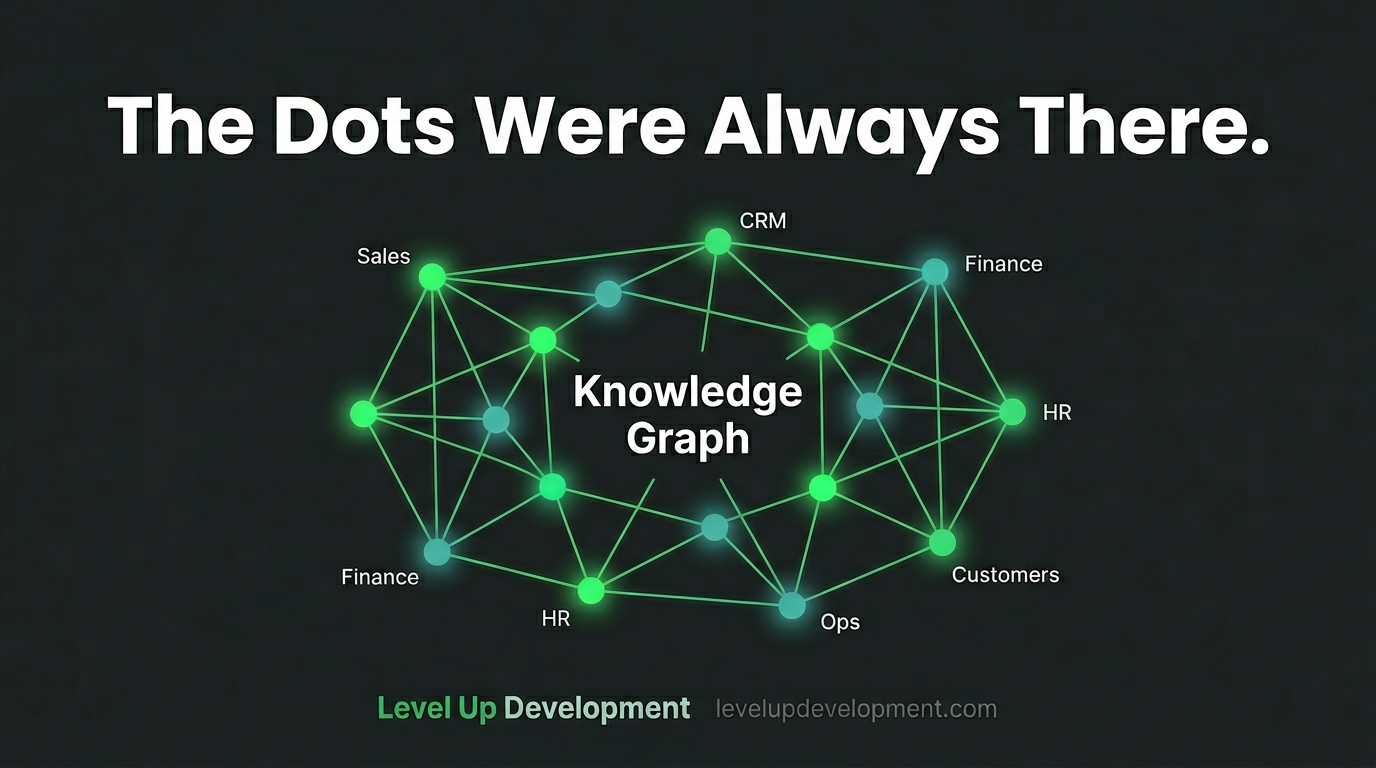
Knowledge Graphs
& AI Agents
Your data already holds the answers. A knowledge graph reveals the connections that were always there — and AI agents act on them.
Beginner’s Guide · No Technical Background Required
What Is a Knowledge Graph?
Think of it as your organization’s memory — one that reveals the relationships that were always there, but invisible across your siloed systems.
“A traditional database is like a filing cabinet — fast at finding a folder, but blind to how the folders relate to each other. A knowledge graph is like a senior employee who has always known every person, project, customer, and deal — and how they all connect. The knowledge didn’t appear out of nowhere. It was always there. Now it’s traversable.”
— The Core Distinction
Nodes — The Things That Were Always There
Every person, product, company, document, event, or concept in your business already exists — as a customer record, a transaction, a support ticket, a file. The knowledge graph doesn’t create them. It makes each one a visible, addressable point in your organizational map.
Entity
Edges — The Relationships That Were Always Real
Customer A always purchased Product B. Employee X always managed Project Y. These relationships existed in reality long before they were captured in any system. The graph doesn’t invent them — it surfaces them explicitly, so they can be queried, traversed, and acted on.
Relationship
Traversal — Following the Path That Was Always There
Ask a question and the system follows edges across nodes to find the answer — even if the answer requires crossing dozens of relationships no human explicitly programmed. The path existed. Now it can be walked.
Query & Reasoning
Why Traditional Data Systems Fall Short
The dots were always there. The connections were always real. Traditional systems just couldn’t see them — so neither could you.
✗ Without a Knowledge Graph
- Connections exist in reality but are invisible across silos (CRM, ERP, email, docs)
- Analysts spend 80% of time finding and manually joining data that was always related
- Context is lost between systems, even when the context was always there
- AI assistants give generic, context-free answers despite vast available data
- Relationships must be hard-coded or re-discovered from scratch
- Institutional knowledge walks out the door when people leave
✓ With a Knowledge Graph
- All existing data surfaces in a single, traversable web of real relationships
- Relationships are first-class citizens — always present, now queryable in real time
- Context follows every query automatically, because it was always connected
- AI agents answer with the full organizational context that was always available
- New relationships emerge through inference on what was always true
- Organizational knowledge persists and compounds — no longer locked in people’s heads
How AI Agents Interact with a Knowledge Graph
AI agents are autonomous programs that can read from, write to, and reason over the knowledge graph — acting as tireless analysts who finally have access to the full picture that was always there.
Agent
Agent
Agent
Agent
Query — Agents Surface What Was Already There
An agent receives a task and queries the knowledge graph, traversing the relationships across sales data, support tickets, usage metrics, and account history that always existed — but were never visible in one place simultaneously.
Read
Reason — Agents Connect the Dots That Were Always There
Using the graph structure plus an LLM, the agent synthesizes relationships into insights: “Account X has had 3 support escalations, no login in 14 days, and their champion changed roles last week.” Every one of those facts existed. The graph makes the pattern visible.
Reason
Act — Agents Take Action on Real, Grounded Intelligence
The agent writes findings back to the graph, triggers workflows, drafts outreach, or hands off to another specialist agent — all traceable and auditable. Every action is grounded in what was always true about your business.
Write / Act
Learn — New Connections Surface Over Time
Every interaction enriches the graph. Outcomes feed back as new edges — revealing relationships that existed but were never captured before. The system’s knowledge compounds, unlike a human team whose knowledge resets with turnover.
Compound Learning
What This Means for Your Business
The value was always locked in your data. The combination of a knowledge graph and AI agents finally releases it — and produces compounding returns across every function of the enterprise.
Speed to Insight
Questions that took analysts days to answer are resolved in seconds — not because the answers are new, but because the connections are finally visible.
Broken Silo Elimination
Finance, sales, ops, and customer data were always related. Now they speak the same language — one query crosses all departments instantly.
Institutional Memory
The expertise, decisions, and context that always existed only in people’s heads now lives in a persistent, queryable graph that doesn’t leave when people do.
Autonomous Workflows
Agents handle routine research, analysis, reporting, and triage — all grounded in the real relationships your business always had — freeing your team for high-judgment work.
Precision & Accuracy
AI grounded in your actual, always-existing data produces context-aware answers instead of hallucinated generalities. The truth was always in your systems. Now it’s accessible.
Compounding Returns
Unlike software tools that depreciate, a knowledge graph grows more valuable with every transaction, decision, and interaction — because every new dot was always connected to something.
Where Leading Organizations Apply This
From Fortune 500 to high-growth startups, the pattern is universal: the data was always there. Connect it, deploy the agents, and accelerate the business.
Customer Intelligence
The churn signals and upsell opportunities were always in your data. Agents now surface them before every sales call — automatically, in context.
Supply Chain Resilience
The relationships between suppliers, logistics partners, and inventory always existed. The graph connects them so agents can predict disruptions before they become crises.
Compliance & Risk
Regulatory requirements always mapped to business processes — that connection just wasn’t visible. Agents now flag violations and generate audit-ready reports on demand.
R&D Acceleration
Patents, research papers, competitor data, and internal findings were always related. Agents surface the non-obvious connections that were always there — and spark innovation.
Talent & Org Intelligence
Skills, projects, mentors, and career paths were always connected. HR agents now match people to opportunities with the full context that always existed across your org.
Personalized Marketing
Purchase history, preferences, and behavioral patterns always told a story. Agents now traverse that story to craft hyper-personalized outreach at scale.
What to Know Before You Invest
Knowledge graphs reveal what was always there — but only if the foundation is built with discipline. Successful deployments share a common rigor.
Key Considerations for Leadership
- Data quality is the foundation — the dots were always there, but dirty data obscures them
- Schema design is a strategic decision, not just a technical one
- Requires cross-functional ownership (data governance must be established)
- Agent autonomy should be introduced incrementally with human oversight
- ROI is highest when the knowledge graph spans multiple business domains
- Security and access control must be graph-aware (not just row/column-level)
- Start with a high-value, bounded use case before enterprise-wide rollout
- Budget for ongoing curation — graphs degrade without maintenance investment
The Dots Were Always There.
The Question Is When You Connect Them.
Organizations that build knowledge graph infrastructure today will have a compounding data advantage — one that surfaces everything that was always in their business, and grows harder to close each year.
