The Pressure Is Real
Your backlog is growing. Your team isn’t. And stakeholders want features shipped yesterday without breaking compliance or introducing regressions.
For years, engineering leaders have been forced to choose between speed and quality. That constraint is finally loosening.
Artificial intelligence has moved from a future trend to an everyday tool for engineering teams. Industry surveys show the majority of professional developers use or plan to use AI tools in their workflows, with daily usage becoming increasingly common.
At Level Up Development, we’ve formalized this shift with our AI-Assisted Software Development service. This operational model integrates generative AI workflows with our SDaaS engineering teams, enabling small and mid-sized businesses to ship high-quality custom software faster without the overhead of building an internal AI program.
We guide every client, from ambitious startups to established healthcare and fintech enterprises, with this principle: successful AI adoption enhances delivery through a clear operating model built on accountability and supportive guardrails.
This article breaks down what AI-assisted development actually is, where it creates the most leverage, and how teams in regulated industries can use it safely.
What Is AI-Assisted Development?
AI-assisted development is a delivery approach where AI accelerates work in the software development lifecycle (SDLC) while human engineers remain accountable for architecture, correctness, security, and outcomes.
It’s critical to distinguish this from “autonomous software engineering.”
Autonomous engineering describes a system where an AI agent can take a general requirement and deploy a complete application with full autonomy. We are actively prototyping this capability internally, with a focus on advancing its readiness for sophisticated, enterprise level systems. Our development is centered on enhancing reliability, context retention, and its performance in real world scenarios.
AI-assisted development, by contrast, is human-led, AI-enhanced. It acts as a force multiplier inside your SDLC:
The AI Role
Acts as a tireless engineer: drafting code, scaffolding tests, generating documentation, and parsing logs at speed.
The Human Role
Acts as the lead engineer and architect: providing context, making tradeoffs, verifying logic, and ensuring the solution solves the actual business problem.
Special Forces
At Level Up Development, we operate like a Special Forces team, with small, versatile units of experts. In this model, AI provides advanced equipment and intelligence support for our operators.
Just as a Special Forces operator relies on specialized gear to execute a mission with precision, our engineers use AI to handle tactical details like boilerplate code, syntax lookups, and data mapping. This frees our experts to focus on the strategic mission: guiding product direction, ensuring stakeholder alignment, and driving business outcomes.
The “Safe Speed” Model: Getting the Benefits Without the Chaos
Before diving into use cases, let’s establish the operating model that makes this work. If you’re a CTO or product manager evaluating AI-assisted delivery, this framework tends to succeed.
Step 1: Define Where AI Is Allowed—and Where It’s Not
| Allowed | Restricted |
|---|---|
| Test scaffolding | Anything involving PHI or PII |
| Refactor drafts | Production credentials or secrets |
| Documentation generation | Clinical decision logic without governance |
| Non-sensitive data transforms | Security-critical code without review |
Step 2: Require Human Ownership of Every Shipped Change
AI can propose. Humans approve. That’s non-negotiable.
Every pull request, deployment, and production change has accountable engineering ownership. We treat AI output as ready for code review, a process also enhanced by AI, with our engineers providing the final verification and approval.
Step 3: Add AI-Aware Security Guardrails
Treat LLMs like a new attack surface. The OWASP Top 10 for LLM Applications highlights risks like prompt injection and insecure output handling. Even if you aren’t building an LLM feature for end users, your development tools need security-first practices.
Step 4: Measure Outcomes, Not “AI Usage”
Track delivery performance:
- Deployment Health
- Deployment frequency (how often you ship)
- Lead time (idea → production)
- Change fail rate (% of releases causing issues)
- Time to restore (how fast you fix problems)
- Customer Impact
- Adoption rate (% of users actually using new features)
- Support ticket volume (spikes after release = problem)
- Feature satisfaction scores (quick in-app surveys)
- User-reported bugs (post-release quality signal)
- Reliability Signals
- Error rates (before vs. after release)
- Performance metrics (latency, load times)
- Rollback rate (how often you have to undo)
- Incident count (SEV1/SEV2 tied to releases)
- Team Velocity (context for above)
- Story points delivered vs. committed
- Sprint predictability (did you ship what you said?)
- WIP limits (are you overloaded?)
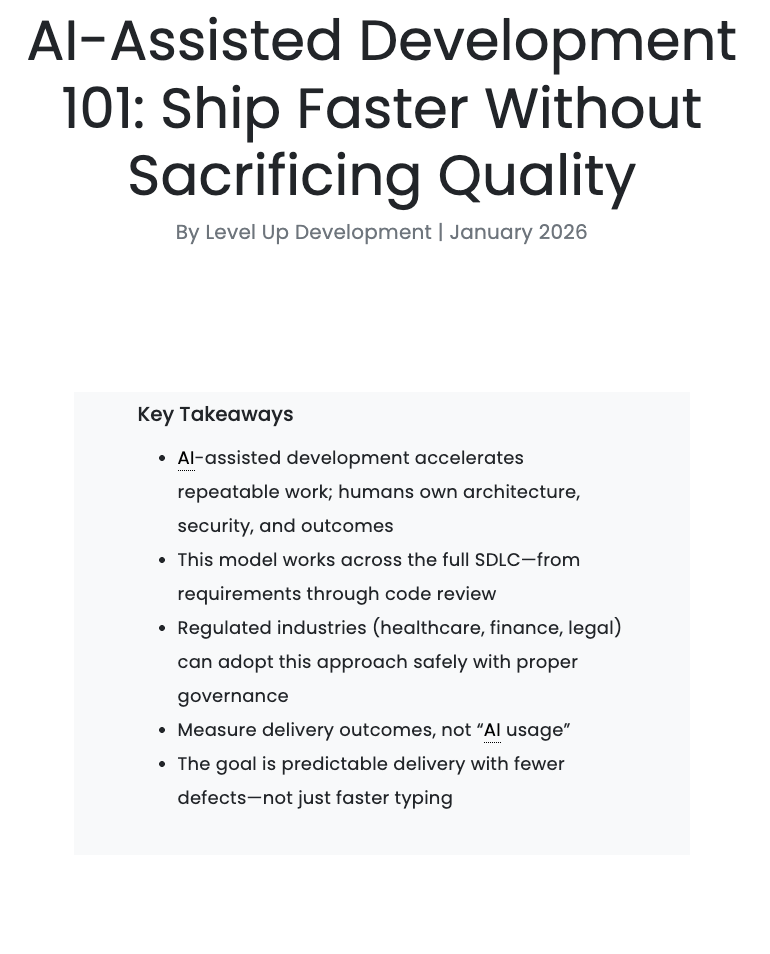
The goal is predictable delivery with improved reliability—not a dashboard showing how many AI prompts your team ran.
Why It Works: The Human-Led Advantage
“By equipping our expert teams with AI-driven workflows, we’re not just coding faster—we’re reimagining how small teams compete with enterprises.”
Here’s why this hybrid model delivers results:
1. Accelerated Velocity Without Sacrificing Standards
When AI handles scaffolding, boilerplate generation, and refactoring assistance, teams can meaningfully reduce cycle time. Published research suggests productivity gains of 30–55% for specific coding tasks when developers use AI assistance effectively.
This velocity matters. When the friction of starting is removed—the “blank page problem”—engineers can tackle hard problems with more energy. We use this momentum to enable rapid prototyping and feature deployment that was previously impractical for smaller teams.
2. Enhanced Reliability and Quality
There’s a misconception that faster code is buggier code. In an AI-assisted model, the opposite can be true—if you use the tools for validation, not just generation.
- AI-driven testing: Generate comprehensive test cases, including edge cases a human might overlook.
- Legacy analysis: AI excels at analyzing legacy codebases to identify hidden dependencies and potential failure points before a refactor begins.
- Pattern enforcement: Catch inconsistencies and risky patterns before they reach code review.
3. Cost Efficiency: Eliminating the Busywork
Mid-market teams often don’t lack talent—they lack time. A significant portion of a senior engineer’s day gets consumed by tasks that are necessary but not differentiating.
AI is particularly effective at accelerating this undifferentiated heavy lifting:
- Writing repetitive CRUD endpoints
- Generating data mapping boilerplate
- Drafting documentation and migration scripts
- Creating test fixtures and mock data
By automating the shape of the work, your investment goes toward architecture, domain logic, and user experience—not typing syntax.
Where AI Fits in the SDLC: A Tactical Breakdown
To implement this effectively, let’s examine each stage of the software development lifecycle. Below are practical use cases, contrasting what AI handles well against what requires human judgment.
1
Product Discovery and Requirements
Before a line of code is written, AI can accelerate understanding of the problem space.
AI‑Assisted Tasks
- Drafting user stories and acceptance criteria from meeting notes
- Turning stakeholder interview transcripts into structured requirements
- Identifying edge cases (“How should this handle offline mode?”)
Human‑Led Responsibilities
- Understanding the real goal—not just what was asked for
- Prioritizing which features drive value
- Navigating organizational politics and stakeholder alignment
2
Architecture and Technical Design
This is where long‑term reliability, performance, and risk tolerance are shaped.
AI‑Assisted Tasks
- Drafting architecture diagrams as text‑based specifications
- Producing Architecture Decision Record (ADR) drafts
- Generating “Option A vs. Option B” pattern comparisons
- Creating initial threat‑model checklists
Human‑Led Responsibilities
- Choosing architecture that matches organizational risk tolerance
- Ensuring the data model accurately reflects the business domain
- Making build‑vs‑buy decisions with full context
3
Implementation and Feature Development
AI accelerates the “typing” work so humans can stay focused on domain logic and product outcomes.
AI‑Assisted Tasks
- Scaffolding endpoints and services
- Drafting data access layers and DTOs
- Generating small utility functions
- Producing first‑pass refactors with guidance
Human‑Led Responsibilities
- Verifying domain logic correctness (for example: billing or clinical rules)
- Maintaining code style and architectural consistency across the codebase
- Documenting the “why” behind key implementation choices
4
Testing and QA Automation
Used well, AI can increase test coverage and speed, while humans ensure tests reflect real‑world behavior.
AI‑Assisted Tasks
- Scaffolding unit tests and parameterization
- Generating mock data and test fixtures
- Suggesting negative test cases (“What if this input is missing or malformed?”)
Human‑Led Responsibilities
- Ensuring tests reflect real user workflows, not just code coverage metrics
- Designing the end‑to‑end test strategy (what to test where)
- Validating that automated tests actually catch the defects that matter to the business
5
Code Review and Maintainability
AI can surface patterns and risks, while humans make the final calls on security, performance, and long‑term health.
AI‑Assisted Tasks
- Summarizing pull requests (what changed, what might break)
- Flagging risky patterns (null handling, concurrency issues, error‑handling gaps)
- Enforcing conventions through automated, policy‑as‑code checks
Human‑Led Responsibilities
- Evaluating security implications of changes
- Confirming performance characteristics under realistic load
- Assessing long‑term maintainability and knowledge transfer for the team
High-Stakes Verticals: Managing Risk in Healthcare, Finance, and Legal
If you build or manage products in regulated industries, you can’t afford to “move fast and break things.” AI assistance must be paired with compliance discipline and governance.
Healthcare: Built for Regulated Environments
The HIPAA Security Rule establishes standards to protect electronic health information (ePHI).
AI‑assisted development works here, but only with clarity on:
- Prompts: What data is allowed? (Best practice: no PHI in prompts)
- Environment: Where do the tools run? (Private instances vs. public APIs)
- Logging: Who can access prompt history?
- Auditability: Can you trace how code was generated and reviewed?
We recommend aligning your delivery process with the NIST AI Risk Management Framework, which helps
organizations incorporate trustworthiness considerations into AI system design.
Use Cases for Healthcare
- Patient portal feature development
- EHR integration scaffolding
- Compliance documentation generation
- Test data synthesis (synthetic, not real PHI)
Note: Compliance requirements vary by organization and use case. We recommend
consulting with your legal and compliance teams when implementing AI‑assisted workflows involving
sensitive data.
Finance: Precision and Auditability
In fintech, banking, and insurance, an AI “hallucination” isn’t just a bug—it’s a liability.
Use Cases
- Drafting algorithmic trading backtesting scripts
- Automating regulatory reporting transforms (SOX, GLBA)
- Fraud detection logic scaffolding
- API integration boilerplate for payment processors
The Risk
AI models are probabilistic, not deterministic. They can generate plausible‑looking but incorrect
calculations or invent regulatory requirements.
The Guardrail
Human engineers own fiduciary responsibility. Every line of financial logic must be verified
by a qualified human. We use AI to build the structure; humans verify the numbers.
Legal: Privilege and Confidentiality
For legal tech and internal counsel tools, the primary currency is trust and confidentiality.
Use Cases
- Summarizing discovery document repositories (eDiscovery)
- Comparing contract clauses against standard playbooks
- Drafting template NDAs or service agreements
- Research organization and citation checking
The Risk
Data leakage. Putting a client’s confidential contract into a public LLM’s training pipeline is
a breach of attorney‑client privilege.
The Guardrail
Strict data sovereignty. Deploy local or private‑cloud AI models that do not train on client data.
The human attorney always provides the final legal opinion.
Partnering With an AI-First Team
As an AI-first consultancy, Level Up Development doesn’t just use these tools—we help build them. Our leadership team has served as the launchpad for AI ventures including Agent700 and EchoTech.ai. This depth in generative AI allows us to navigate complexities that standard development shops miss.
If you’re evaluating a partner, ask these questions:
| Question | What You’re Looking For |
|---|---|
| What’s your policy on PHI/secrets in prompts? | Clear governance, not “we’re careful” |
| Do you have an AI-aware code review process? | Specific checklist, not just “we review everything” |
| Have you delivered AI-assisted projects for regulated industries? | Relevant experience, not just enthusiasm |
| Do you view AI as a replacement for engineers or a tool for them? | If they say replacement, find another partner |
What’s Next?
AI-assisted development isn’t about replacing your engineering team or adopting every new tool that appears. It’s about giving skilled humans better leverage—shipping faster without sacrificing the quality, security, and reliability your customers expect.
The teams that figure this out first will have a meaningful advantage. The ones that wait will find themselves competing against organizations that can deliver in weeks what used to take months.
Have questions about how this approach might work for your specific situation?
We’re happy to talk—no pitch, just a conversation about what’s realistic for your team and timeline.
